
Stocks or Bonds?
January 6, 2025
In the previous three recessions in the United States, the stock market crashed by approximately 30%, 40% and 50% (2020, 2007-08, and 2000-01). The chart below shows historical recessions in the U.S. (the gray horizontal bars), juxtaposed with the Fed Funds Rate (this is the rate everyone is talking about when the Fed 'raises' or 'lowers' rates).
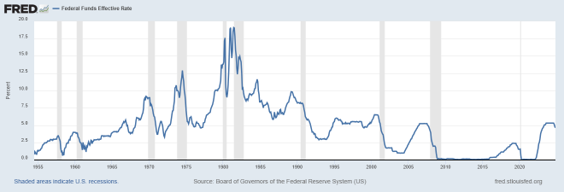
In each of these recessions, the stock market eventually bounced back, but the timeline was variable. The pandemic recession was shortlived, and investors who did not panic and held their stocks saw their gains recovered in a year. However, investors who bought at the height of the dot-com bubble entered the infamous 'Lost Decade' of the S&P 500, as it took the better part of a decade to recover losses.
More importantly, each of the previous three recessions occurred after the Fed had raised interest rates. The graph is clear. Economics is not an exact science, but there is a general truth that recessions follow after the Fed raises interest rates. In the last 2 years, the Fed has greatly raised rates. So far, we have not yet entered a recession, and the stock market certainly has had some good years, but it is my firm belief that the risks to owning stocks right now are awfully high, and that the odds of a recession are higher than general consensus. The Buffett Indicator is a famous rule which puts the overall value of the stock market as the numerator, and the value of our economy (GDP) as the denominator. This also shows that the stock market is overvalued by a historic amount.
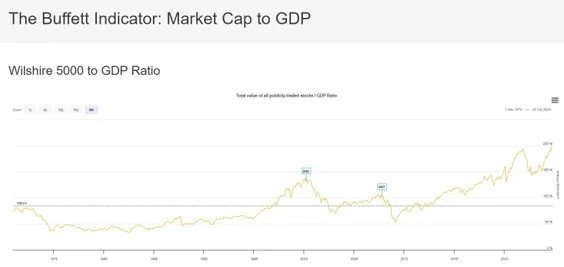

As in previous market bubbles, there are ample arguments about why this isn't a bubble, and the good times will continue forever. I'm not a perma-pessimist, I have often encouraged my clients to buy stocks when they were obviously undervalued (most recently the pandemic crash, and of course '07-'08). But I just don't buy the bullish arguments right now.
The first argument is that the economy is doing great, so why worry? This ignores several data sets. First, the failure of Silicon Valley Bank and others in 2023. The mini-banking crisis was so severe that the Federal Reserve instituted an emergency 12-month line of credit known as the Bank Term Funding Program. Multiple other banks were in a precarious position, and they borrowed of $160 Billion to stay afloat They have been forced to repay that money, and we can only hope that they are in a better position today. We know that hundreds of billions of dollars of 5-year corporate loans that were issued in 2020 at low interest rates will come due this year. Many borrowers will default, which will only put further pressure on the banking system.
Second, we also know that real wages have been consistently falling for several years, and that consumer credit is also shrinking. In other words, there are plenty of cracks showing in an otherwise healthy economy. So why has the economy chugged along, avoiding a recession, if the Fed's high interest rates are trying to slow it? The answer: the last few pandemic bucks. The Fed printed so much money during pandemic, that the banks had nowhere to put it all. So they loaned it back to the Fed (this is known as Reverse Repo), so they could earn 5% free money on the free money they had been given. Here's a chart of the Reverse Repo money:
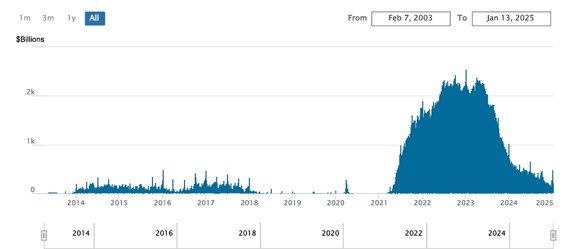
Over the past several years, as the Fed has been raising rates to slow inflation and slow the economy, the banks have been simultaneously lending the approximately $2.5 Trillion of Reverse Repo money. One foot was on the gas pedal, but the other foot was on the gas. The size of the cash pile has been enough to keep stocks up and economic growth positive. Finally, almost 5 years after the first covid cough, the pandemic money is on its last gasps. The final dollar of pandemic stimulus money has been spent. I see the threats to economic growth continuing to gather steam.
“Again, it's my opinion, given current equity valuations, that the stock market is overly optimistic about the future. On the flip side, given all of the continuing fears around inflation, it's also my strong opinion that bonds are overly pessimistic about inflation and, hence, undervalued.”
Here's a historical chart of inflation in the U.S., as measured on a quarterly basis. There are multiple ways to measure inflation, this is core PCE, the favored gauge of the Fed Open Market Committee (FOMC).
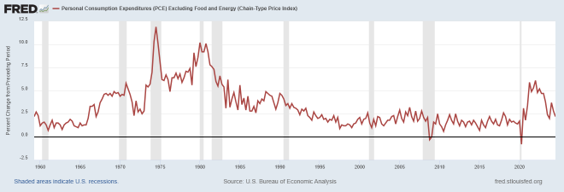
This graph shows the pandemic inflation spike, going as high as 6.1% in the 2nd quarter of 2022. Since then the quarterly rate has fallen to 2.2%, a whisker away from the Fed target of 2%. Meanwhile, U.S. Treasuries have sold off, and are yielding almost 5%. The fear is that inflation is going to move higher from here. The numbers, in my opinion, show that inflation has been beaten. In order for inflation to move higher from here, we need consumers to start spending even more. This is, after all, the definition of inflation - too much money chasing not enough goods So let's look at the U.S. consumer - how many are planning to greatly increase their spending in 2025?
Again, real wages have been consistently falling for the past few years, and are back to pre-pandemic levels. In addition, it's kinda hard to borrow money when mortgages are at 7% and credit cards are sky high. So consumer lending is also declining. Simply put, the fear of inflation is exactly that. Fear. Inflation continues to fall, the consumer continues to be constrained, this all adds up to a recessionary environment, not an environment of accelerating growth. Fear usually presents a great buying opportunity. Too much fear of covid presented a great buying opportunity in stocks. I believe too much fear of inflation presents a great buying opportunity in bonds.
There is one final variable that I haven't discussed. Trump. Love him or hate him, the investment world is absolutely focused on his economic policies. Not surprisingly, I believe the stock market is overly optimistic about the stimulus effects of tax cuts, and the bond market is overly pessimistic about the effects of tariffs and government spending.
First, let's talk about tariffs. The bond market is worried that tariffs will cause inflation. But if free trade is good for global economic growth, then won't tariffs constrain economic growth? The Fed itself has said that tariffs provide a temporary boost to inflation. Even then, most of the inflation basket in the U.S. is domestic inputs (shelter, etc), so the pressure on inflation from tariffs would be temporary and smaller than feared. Meanwhile, the recessionary effects of tariffs are huge. Most of the S&P 500 consists of companies that buy and sell globally. Tariffs will destroy profit margins for importers, and retaliatory tariffs will destroy profit margins for exporters. A true global trade war would equal a crashing stock market. Trump doesn't want that. I imagine Trump will dial back the worst of his tariff threats, instead using them as negotiating leverage Inflation should continue to move back toward the Fed target.
Second, let's talk about the Trump tax cuts. 2017-Trump was in a win-win situation. The Bush-era tax cuts had expired under Obama, so Trump entered office with a relatively high tax rate. It's easy to cut high taxes. So he did. He also had a 23-person majority in the House of Representatives. Even though 12 Republicans voted against the bill, it still passed.
2025-Trump is in a lose-lose situation. Taxes are already low. It's hard to cut low taxes - the House Freedom Caucus has many members that oppose adding to the deficit. The 23-person majority in the House in 2017 is now a 2-person majority. Trump simply doesn't have the votes to pass an extension of the current bill. The Republicans have vowed to come up with a new plan, but the math is daunting. Remember when Republicans vowed to repeal Obamacare? And Republicans controlled the House, and the Senate, and Trump was president, and they voted to repeal Obamacare? Yup, we still have Obamacare.
In my opinion, the stock market is discounting the odds that the tax cuts simply expire in 11 months, which would almost certainly precipitate a recession, assuming we aren't already in one.
Of course, the Republicans could also find a way to somehow extend most of the tax cuts. That is a Herculean task, but maybe they can do it. If so, it does nothing for the economy. An extension simply means your taxes aren't going up. On January 1st, 2026, everyone would wake up with the same tax rate, same debt levels, same income, that they did the day before. This scenario isn't recessionary, but neither does it add any stimulus to the economy. This is the lose-lose proposition for Trump today. Fail to extend tax cuts, and be blamed for a recession. Succeed, and deliver a nothingburger to his constituents, and maybe a post-pandemic recession anyway.
In summary, stocks are too expensive for my taste, and bonds look like they are in a historic buying opportunity. As 2025 progresses, I anticipate cooling economic growth, and the fears and hopes around Trump's policies should start to come down to earth as Congressional gridlock becomes apparent.
Please keep in mind that all of this is my opinion, and should not be construed as financial advice for you as an individual. You should consult with an advisor before making any investment decisions for your own situation.
PRIVILEGED AND CONFIDENTIAL: This communication, including attachments, is for the exclusive use of addressee and may contain proprietary, confidential and/or privileged information. If you are not the intended recipient, any use, copying, disclosure, dissemination or distribution is strictly prohibited. If you are not the intended recipient, please notify the sender immediately by return e-mail, delete this communication, and destroy all copies.
Naylor Asset Management is a Registered Investment Advisor in the state of Minnesota.