
Tariffs and Inflation
April 07, 2024
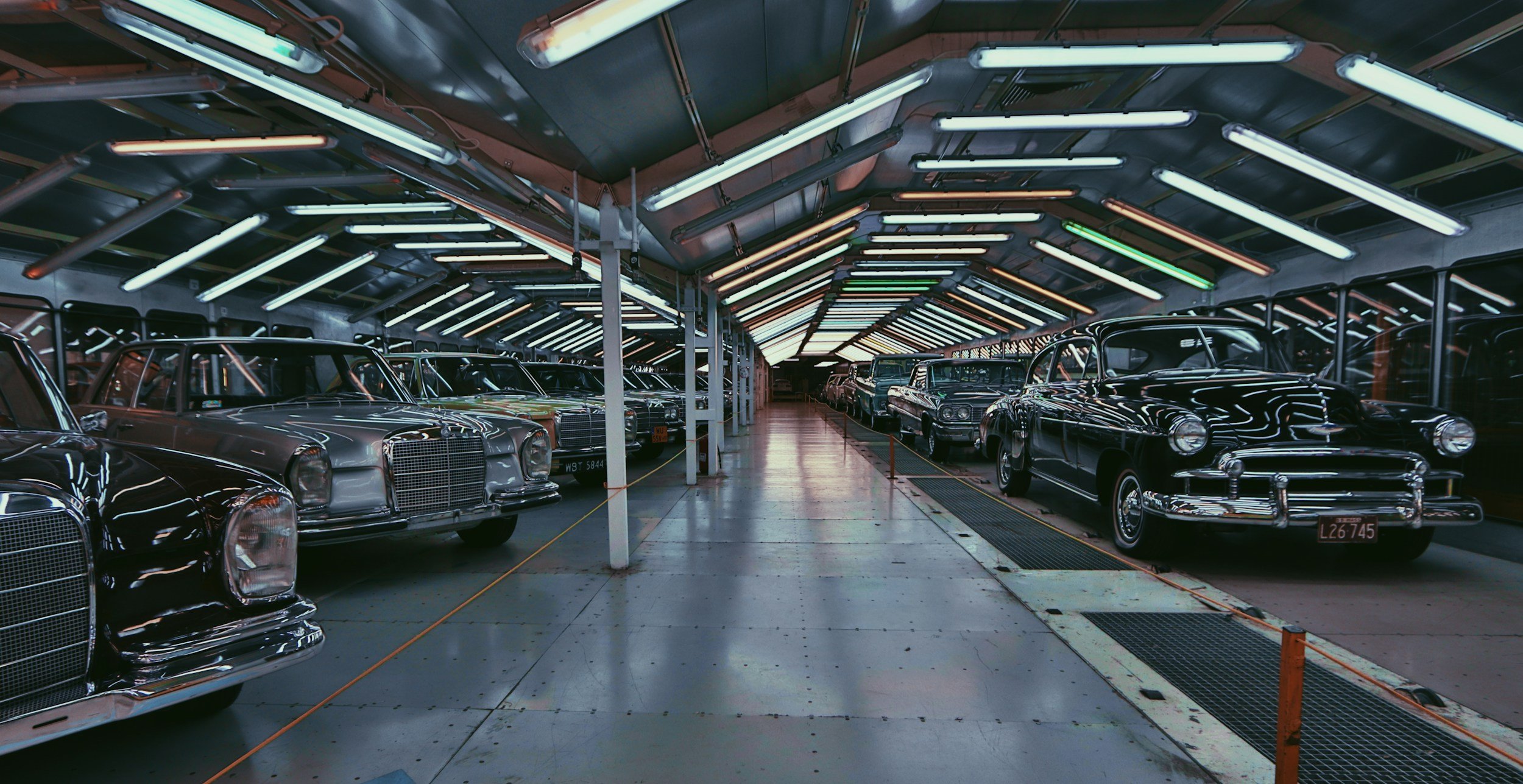
President Trump has announced significant tariffs on the automotive industry, and has planned even more tariffs for 'Liberation Day,' April 2nd, next week. Most economists are projecting inflation to have a modest rise, perhaps 1% to 1.5%, as a result. Meanwhile the Federal Reserve is talking about heightened 'uncertainty.' Will inflation or deflation carry the day? Why is the Fed nervous, and why do 20% and 25% tariffs result in only small changes to inflation? Let's look at some numbers. Here are the official ingredients of the Consumer Price Index (CPI), one of the inflation barometers used by the Fed.
| Item Title | CPI Item Weighting | |
|---|---|---|
| Owners' equivalent rent of primary residence | 25.083 | |
| Rent of primary residence | 7.499 | |
| New vehicles | 4.393 | |
| Gasoline (all types) | 2.902 | |
| Limited service meals and snacks | 2.845 | |
| Motor vehicle insurance | 2.796 | |
| Full service meals and snacks | 2.434 | |
| Used cars and trucks | 2.391 | |
| Electricity | 2.343 | |
| Hospital services | 1.932 | |
| Physicians' services | 1.824 | |
| College tuition and fees | 1.324 | |
| Wireless telephone services | 1.281 | |
| Unsampled owners' equivalent rent of secondary residences | 1.198 | |
| Other lodging away from home including hotels and motels | 1.049 | |
| Dental services | 0.944 | |
| Internet services and electronic information providers | 0.926 | |
| Prescription drugs | 0.925 | |
| Airline fares | 0.918 | |
| Club memberships | 0.817 | |
| Health insurance | 0.793 | |
| Utility (piped) gas service | 0.750 | |
| Water and sewerage maintenance | 0.738 | |
| Admissions | 0.738 | |
| Day care and preschool | 0.724 | |
| Personal care services | 0.659 | |
| Cable, satellite, and live streaming television service | 0.653 | |
| Pets and pet products | 0.632 | |
| Services by other medical professionals | 0.600 | |
| Other miscellaneous foods | 0.564 | |
| Top 30 Items Weighting Total | 72.675 | |
| All Others | 27.326 | |
| Total | 100.000 |
The cost of cars and trucks makes up less than 6.8% of the overall CPI 'bucket.' So 25% car tariffs will not result in 25% overall inflation, not even close. On top of that, some news outlets infuriatingly repeat the phrase that the cost of the tariffs is going to be 'passed on to the consumer.' If Ford and GM could simply raise prices by 25% and pass it on to the consumer, well, they would have done that a long time ago. The reality is that cars today are more expensive than they have ever been, with many consumers taking out 5, 6 and even 7- year term car loans, and still ending up with car payments over $1,000 per month. Automakers will instead have to absorb some of the tariff cost out of their own profits, then try to raise prices as much as possible. Regardless, automakers are looking at a dire situation. Higher prices results in falling sales, falling revenue, and falling profit. Plus falling profit from absorbing some of the tariffs. It is only bad news for carmakers, and likely means layoffs and idled factories. Car exports are such a big part of the Japanese and European economies, recessions are all but guaranteed.
We haven't yet talked about the next round of tariffs. And we haven't yet talked about the retaliatory tariffs either. But I digress.
This leads to my next point - a small tariff might mean price increases, but a global tariff war almost inevitably means a recession and falling inflation. Reference back to the CPI ingredients list - most of the U.S. inflation gauge is comprised of domestic inputs, somewhere between 60 and 75%. In fact, the cost of housing by itself is over a third of the inflation gauge. Housing costs are ultimately determined by the unemployment rate, not by the cost of lumber. There are about 150 million homes in the U.S., and new construction adds less than 1% to that number each year. So lumber costs have a very small impact on the cost of housing - the primary determinant of housing costs is unemployment. Here's a chart that shows the relationship between unemployment and inflation over the last 25 years.
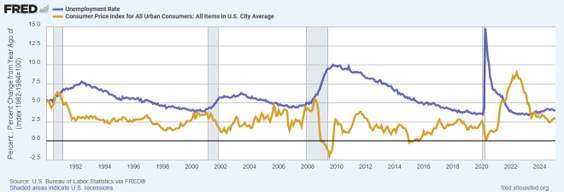
The blue line is unemployment and the orange line is inflation. You can see a gentle 'mirror' effect between the two lines. In each of the last 4 recessions, the blue line moves up, as millions of people unfortunately become unemployed.
“Demand for housing goes down. More people live with roommates. Young adults stay with mom and dad. Apartment rents fall, and since this is over a third of the inflation gauge, the orange line of inflation also falls.”
In addition, of course, in a recession people are generally spending less money in other areas of their lives, leading to falling demand everywhere.
In the last 4 recessions, inflation dropped by a whopping 4.0 percentage points on average. The models today are calling for the tariffs to add something like 0.5% to 1.5% to inflation. Hence, the Fed is using the term 'uncertainty.' If you have an inflation headwind from tariffs (plus 1.5), and an inflation tailwind from a slowing economy (minus 4), which force is greater? It partly depends on your worldview. This Fed is a particularly hawkish Fed. Inflation today is somewhere between 2 and 3%, depending on how you measure it. This is down from a high of 9% just a few years ago. The Fed's official target is 2%, so your author looks at those numbers and concludes that inflation is basically vanquished for this particular cycle. The Fed, however, can only see the glass as half empty. To them, every shadow is the shadow of inflation. Bad news is bad news, and good news is probably only temporary. By keeping interest rates high, exactly when Ford and GM and their customers could use lower interest rates to help offset the higher tariffs, they are only accelerating the onset of recession. Official measures of consumer confidence have plummeted to recession-like levels, and that is essentially a death knell for the American economy which famously runs on the strength of its consumers. There is still a prevailing counter argument - the tariffs are not real, this isn't really happening, Trump will change his mind. I would encourage you to read the official announcement of the automotive tariffs from the White House:
Fact Sheet: President Donald J. Trump Adjusts Imports of Automobiles and Automobile Parts into the United States – ]
Notably missing from this broadside is any mentions of ‘fentanyl’. Whether you agree or disagree with the President, these tariffs come from deeply held conviction. Not a bluff. Not a negotiating tactic. Starting in 1985, America has lost a huge number of manufacturing jobs. President Trump sees it as his voter mandate to fundamentally change the economy. He was recently asked if he is worried about these changes causing a recession. He essentially shrugged his shoulders and say 'maybe.' ... but reiterated that we will all be better off in the long run.
This is and isn't the Trump of 2017. He desperately wanted to put tariffs on the auto industry in 2018, but was talked out of it. He has vowed not to repeat the mistakes of his first term. I believe the tariffs are here to stay. Most companies will be forced to take a hit to their profits, and will also pass on some of the cost to their customers. Stretched consumers will have to spend even less on discretionary goods, focusing more on the essentials. Falling sales, falling revenue, and falling profits is a recipe for further stock declines. American companies will ultimately have to shed workers as their sales decline, leading to a recession.
The last three recessions saw stock declines between 30-50%. The only good news is that recessionary investing is extremely simple. Cash, Treasuries and gold are basically the only three asset classes that do well in a recession. Of those three, only Treasuries continue to trade at a double-digit discount to their values from several years ago.
Obviously I have some strong opinions about current market conditions, but please do not take any of this as investing advice for your own personal situation. Consult with your financial professional before making any changes. Maybe take a few deep breaths. If you found this article to be interesting, please feel free to forward to friends and family. If you found it to be boring and stupid, maybe send it to some of your worst enemies. What the heck, it's a free country.
PRIVILEGED AND CONFIDENTIAL: This communication, including attachments, is for the exclusive use of addressee and may contain proprietary, confidential and/or privileged information. If you are not the intended recipient, any use, copying, disclosure, dissemination or distribution is strictly prohibited. If you are not the intended recipient, please notify the sender immediately by return e-mail, delete this communication, and destroy all copies.
Naylor Asset Management is a Registered Investment Advisor in the state of Minnesota.