
Watching Inflation
June 07, 2023
One of Waren Buffett's classic investing principles is 'be greedy when others are fearful, and be fearful when others are greedy.' I continue to be fearful of a stock market that seems to be increasingly disconnected from slowing global economic growth. And I continue to see great value in bonds, although fear of inflation that runs rampant in the financial media certainly keeps bonds less popular than stocks. For this update I will focus on inflation.

There are a handful of popular arguments for higher inflation. The most obvious is tied to tariffs - going forward I'll use the more accurate term 'import taxes.' In 2024 total U.S. GDP, the size of the American economy, was $28.47 Trillion. In contrast, total imported goods and services were a much smaller $3.36 Trillion. Imported goods are not significant enough to cause a large spike in inflation - the vast majority of our GDP is domestic, not foreign. In other words, consider the dollar amount you spent last month on rent or your mortgage, and then contrast that dollar amount with your spending on imported avocados. Even with our global economy, the vast majority of our spending is domestic, not foreign. Import taxes will put upward pressure on those prices, certainly. But what about everything else? History shows that import taxes, and retaliatory import taxes, lead to higher unemployment and reduced overall spending. Unemployment in Canada has risen from 5.7% at the beginning of 2024 to 6.9% today. Canadians in turn have cancelled flights to the U.S., and boycotted America booze. The aggregate effect of the tax is lower economic activity and lower economic demand, which leads to lower prices, not higher.
Now might be a good time to say: I am NOT arguing in favor of import taxes, I am simply pointing out that some of the fears around inflation are overblown. Look at the prices of oil and corn over the last 12 months, down about 14% and 12% respectively. China has retaliated against U.S. import taxes by curtailing food purchases. Corn is a key factor in all of our food, including for our chickens, pigs and cattle, and that price is falling. The oil market sees fewer ships sailing between countries, and fewer travelers, leading to lower demand and lower prices. Import taxes can cause some price increases in some areas, but those are ultimately overtaken by falling prices in other areas.
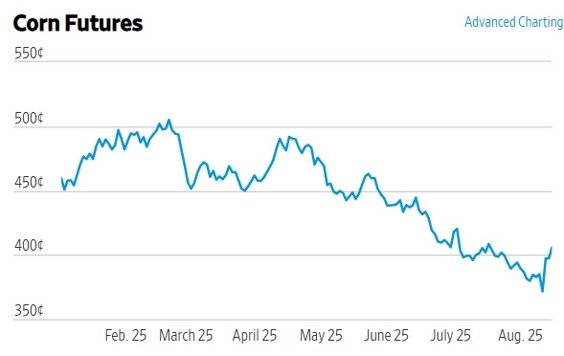
There has been a tiny uptick in inflation in the last few months, a few tenths of a percent, but I don't believe import taxes will lead to significant, sustained inflation. But I am certainly watching three other areas that could potentially re-stoke inflation. First, wage growth - Americans who earn more tend to spend more. Second, any stimulus money from the Federal Reserve. And third, any additional stimulus spending from the federal government. Let's check the charts on those three categories, starting with the chart below showing wage growth and inflation. Going back almost 15 years, the blue line is wage growth and the red line is inflation (as measured by CPI).
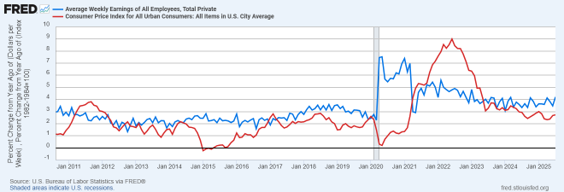
There are a couple of key takeaways from this chart. First, if you could take a time machine to 2021 and 2022, your fears of wage inflation would be 100% accurate. Today, not so much. Both inflation and wage growth have moved lower over the past few years. I believe the wage inflation between 2020 and 2021 played a role in the ensuing inflation spike. But don't forget the three separate checks that every American received between 2020 and 2022 as part of the three separate stimulus programs. Those programs coincide directly with the spike in inflation. If I saw the blue line moving up in 2025, I'd be worried about inflation, but wage growth has normalized. If you look at wage growth prior to pandemic, it usually runs above the inflation rate. In other words, wage growth can be 4%, and inflation can be 2%, as long as productivity saves us another 2%. Could wage growth pick up again? Anything is possible, but today's labor market is soft and I don't see any hard data, or anecdotal data, to support an argument for wage inflation.
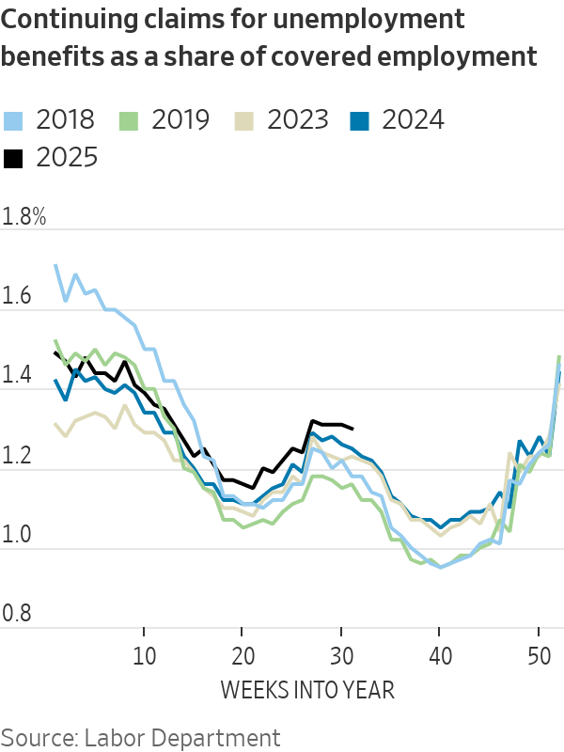
The next chart shows continuing claims for unemployment - people who have lost their jobs and are unable to find work. This chart excludes the extreme pandemic years, but it also shows that this is a terrible year to be unemployed. Employers have not conducted mass layoffs, so the unemployment rate is relatively unchanged, but employers have also suspended hiring. The labor market is not healthy, and the Fed is keenly aware that if it gets worse, it can be very hard to stop rising unemployment without large interest rate cuts, and theoretically even turning the printing press back on, depending on the severity of any downturn. Wage growth has stalled out, and I think continued declines in wage growth are more likely than not.
What about the possibility of the Fed printing money and causing inflation? Let's look at the chart on that one - here's a chart that shows what the Fed is doing with money supply.
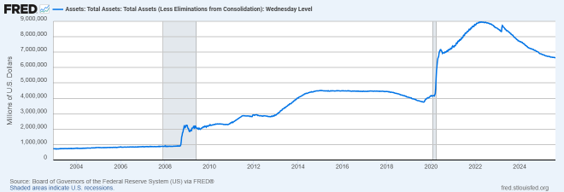
This line shows the amount of stimulus added, or withdrawn, from the economy by the printing press. In 2008 the Fed printed a ton of money. In 2020, same thing. However, the Fed is now removing $20-30 Billion from the economy every month - the line is going down, not up. Iin the old days, this would entail burning actual cash, today everything is electronic. You can see that the pandemic money printing from 2020-2022 coincides with the inflation spike. Now the Fed is slamming on the brakes, pulling money from the system, and of course inflation has fallen significantly from over 8% to below 3%. If the Fed decided to start printing money again, I'd be worried about inflation. However, they are doing the opposite. It would take another massive crisis to change course - AIG and Lehman brothers. Coronavirus. Etc. Absent a cataclysmic event, they continue to apply the brakes to the economy. This is the opposite of inflationary.
The third area that would make me worry about resurgent inflation would be additional government spending. We saw the inflationary effect when the government sent everyone stimulus checks during pandemic. Demand soared, supply was constrained, and prices soared. So what kind of stimulus can Americans expect in 2026 from the Big, Beautiful Bill? You can safely budget 0 dollars of additional money in your pocket. The whole point of that legislation was to prevent the expiration of the 2017 Trump tax cuts. On January 1st, 2026, instead of seeing a big tax increase, your taxes will simply stay the same. It avoids a tax hike, but it doesn't put any new dollars in anyone's pocket. Yes, there are a few small exceptions, but nothing huge.
In other words, I don't see resurgent inflation as a threat to bond holders. Instead, I see continued falling growth as a threat to overvalued stocks. The data is clear - workers are not getting any big pay increases. The Fed isn't sending anyone money. The federal government isn't sending anyone money. As the new import taxes take hold, business activity should continue to decline. The risk of layoffs increases in this scenario. President Trump and his Treasury Secretary Scott Bessent have both explicitly acknowledged that raising taxes on imports could cause a recession. But they also believe that the long term benefits outweigh any short term pain. Trump has called naysaying Republicans 'panicans,' meaning, don't panic if there is a recession, it will all work out in the end.
Both Elizabeth Warren and Donald Trump have been calling for Jay Powell, the Fed Chairman, to lower rates. I try to be apolitical in these articles, but I can safely say that I agree with Warren and Trump. Powell just hasn't done a great job. He didn't start to raise rates from the pandemic 0% until March of 2022 AFTER inflation hit 8%. In other words, in December 2021 inflation was at a whopping 7% and Powell had the Fed rate at an insanely low 0%. Today, inflation is less than half that, below 3%, and he has the official rate at 4.3%. He was running the printing press at exactly the wrong time because he was so preoccupied with coronavirus that everything else was secondary. And today, he is slamming on the brakes at exactly the wrong time because he is so preoccupied with import taxes. Here is the chart:
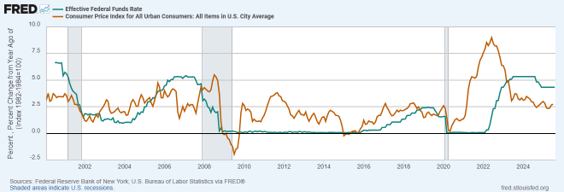
The cost of too much stimulus is inflation - and we definitely got inflation. The cost of too much restriction from the Fed is unemployment. A growing unemployment rate is what Powell should be afraid of, and he should be lowering rates just as Elizabeth and Donald have said. The stock market seems to be increasingly detached from the slowing real economy, and bonds continue to look like the safe haven investment that is unpopular, until it isn't.
PRIVILEGED AND CONFIDENTIAL: This communication, including attachments, is for the exclusive use of addressee and may contain proprietary, confidential and/or privileged information. If you are not the intended recipient, any use, copying, disclosure, dissemination or distribution is strictly prohibited. If you are not the intended recipient, please notify the sender immediately by return e-mail, delete this communication, and destroy all copies.
Naylor Asset Management is a Registered Investment Advisor in the state of Minnesota.