
The Bond Market gets interesting
October 9, 2026
Every once in a while the boring market for municipal bonds becomes a really interesting market. The chart below shows the performance of a municipal bond ETF over the last several decades.

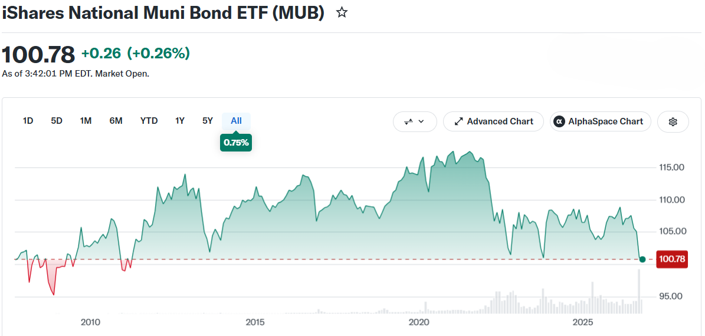
You can see the recent bond market selloff has brought this fund to one of its lowest prices in many years. In fact, the only time municipal bonds had bigger losses was during the banking crisis of 2007. Banks have historically been large buyers of municipal bonds, and during the global crisis in 2007 they were forced to sell bonds even at a loss. Eventually the government and the Fed stepped in to save the banking system.
My point is: it is unusual for municipal bonds to sell off like this. Banks today hold fewer municipal bonds than they did in 2007 due to regulatory changes, but the overall bond selloff has affected all bond markets, including the Treasury notes that are also a large component of bank reserves. It is likely that the recent global rise in interest rates (which is the yield on bonds) is causing some level of stress at banks around the world. As yields have risen in the last month or two, some major banks in the U.S. have seen their shares decline by 10% or more, while smaller banks have seen even greater share declines. Societe Generale, one of the big European banks, has seen its share value drop by approximately 25%. Most banks won't face the fate of Silicon Valley Bank, but some might. The healthy ones are still facing liquidity challenges as the value of their reserves declines, which is ultimately bad for bank lending and economic growth.
Stocks have weathered the bond selloff in the last few weeks with relative aplomb, but there are questions about how long they can fight against the headwind of higher rates. The data shows that there are already strains in the financial markets. The chart below shows the CCC Option Adjusted Spread spiking from 9 or 10% in the last few years to over 12% in just a few months. Companies rated CCC or lower are the highest risk borrowers - this pool of borrowers is the first to see problems when there are funding issues.
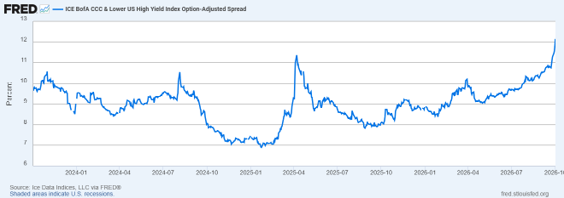
In mid 2025, the average CCC-rated company was paying a rate of around 11% to borrow in the bond markets (4% on a Treasury plus the 7% spread as indicated in the chart). Today that 11% has jumped to 17% (5% in the Treasury market plus the 12% spread).
Going from 11% to 17% as an AVERAGE is a big deal, and it means that the recent bond selloff is causing some real problems. This probably means more corporate bankruptcies if that rate stays elevated. Also, if 17% is the average, that means some are borrowing at 20% or higher which becomes unsustainable. This also slows growth as companies are less likely to be expanding operations when their borrowing costs are so high.
I am firmly in the camp that the recent bond selloff is a negative for economic growth and a negative for the stock market. The data are also in agreement here - more than half of all the stocks in the S&P 500 have declined in 2026. But the way the index value is calculated for the S&P 500 is not a democracy - bigger companies carry a bigger weight. So a handful of massive tech companies have propelled the overall index higher for the year, while the average company has actually declined. This divergence is unusual, and as others have noted, the last time this divergence was so extreme was during the dot-com bubble.
In other words, the global selloff in government bonds and the rise in rates is sending an obvious signal - too many entities are borrowing too much money, and the financial system is simply running out of ample funds to finance all the borrowing. The problem for stocks is that they get their money or liquidity from the same river that feeds the government bond market. If the bond market continues to pull more money from the river, ultimately less and less liquidity reaches the stock market.
Although many economic sectors are struggling, there remains robust investing and excitement around Artificial Intelligence (AI). There is no question that AI will be a revolution akin to the original internet revolution, but the bigger question for investors is whether future profits are worth the massive upfront costs.
The governor of the Bank of England, Andrew Bailey, recently gave an interview expressing concern about the massive level of borrowing that has been funding the AI expansion. 'Google was not the first leader in internet search,' he said. 'It was Netscape. Nobody can remember Netscape today. It doesn't exist. When asked directly about whether or not he was worried about an AI bubble bursting he stated 'You could see some correction of asset prices at some point.' Given his role as governor of a major central bank, those are some striking words. Framed a different way, if I'm not paying anything to use Google today, why would I pay anything to use ChatGPT tomorrow? If AI is simply a competitor to Google, then we can expect lower long term profits as the AI companies are forced to compete with each other. If AI competes with other software companies, that implies a future of winners and losers, of Googles and Netscapes. Higher interest rates might end up being the winnowing tool that separates the two. They certainly played a significant role in the dot com correction, as Alan Greenspan raised rates and made his famous comment about 'irrational exuberance.'
As always, please feel free to forward this to family and friends. None of the preceding should be construed as investment advice, it should be taken strictly as market commentary and observation.
PRIVILEGED AND CONFIDENTIAL: This communication, including attachments, is for the exclusive use of addressee and may contain proprietary, confidential and/or privileged information. If you are not the intended recipient, any use, copying, disclosure, dissemination or distribution is strictly prohibited. If you are not the intended recipient, please notify the sender immediately by return e-mail, delete this communication, and destroy all copies.
Naylor Asset Management is a Registered Investment Advisor in the state of Minnesota.